Review: Twyla Tharp Dance
Sep 28th
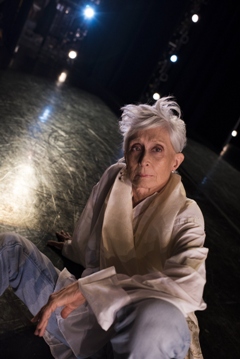
Twyla Tharp
(©Robert Whitman)
Dance lovers attending Twyla Tharp Dance will get a wonderful surprise when they show up at the Joyce Theater, and sorry, it’s about to be spoiled here. The program includes an update announcing an addition to the evening’s line-up, “Entr’Acte,” to be danced by the company to the music of, among others, Blind Willie Johnson, Roy Eldridge, John Laurie and Franz Schubert. It isn’t until the piece begins about midway through the evening that audiences discover just what a treat they’re in for.
Tharp herself comes onstage, instantly garnering a standing ovation. She proceeds to introduce the piece by informing us that it will reveal how she and the company “spend our days.” What ensues depicts a rehearsal, with the legendary choreographer herself taking part, at first simply issuing instructions but eventually joining in the dance. At age 76, Tharp’s lithe physicality and no-nonsense presence remain undiminished, and while the piece itself is little more than a novelty, it was so delightful to see her dance again that it instantly became the evening’s highlight. Especially when she jokingly remarks, “The language of dance has always eluded me.”
With her appearance, Tharp essentially upstaged herself, or at least “Dylan Love Songs,” her long-awaited new piece receiving its world premiere. Tharp’s second effort using the singer/songwriter’s music after her ill-fated 2006 Broadway musical The Times They Are-a-Changin’, the work is performed by five dancers with the addition of John Selya (a Tony nominee for Tharp’s Movin’ Out) who, clad in a black coat and hat, seems to be representing Dylan. It presents a series of duets and solos danced to seven Dylan classics including “Shelter from the Storm” and “Things Have Changed.” While not particularly distinguished choreographically, the superb dancing and iconic music nonetheless pack an emotional punch.
The two rarely seen vintage works on the program proved more satisfying. 1972 “The Raggedy Dances,” performed to ragtime-style piano music composed by Scott Joplin, Charles Luckeyth Roberts, William Bolcom and Mozart’s variations on the melody that inspired “Twinkle, Twinkle, Little Star”, it’s a charmingly exuberant showcase for five loose-limbed dancers including Kara Chan, whose diminutive stature and style recalls a young Tharp. An even earlier piece, 1970’s “The Fugue,” features Chan, Reed Tankersley and Kellie Drobnick performing rigorously executed rhythmic variations unaccompanied not by music but rather the sound of their stomping feet on the amplified stage.
Although Tharp has no permanent ensemble of her own, you wouldn’t know it from the cohesion and discipline exhibited in this superb evening that has become the dance hit of the fall season. And the opportunity to see the award-winning choreographer in the flesh is not one to be missed.
Joyce Theater, 175 Eighth Ave., New York City. Through Oct. 8. 212-242-0800. www.Joyce.org.
Review: Sweeney Todd
Mar 10th
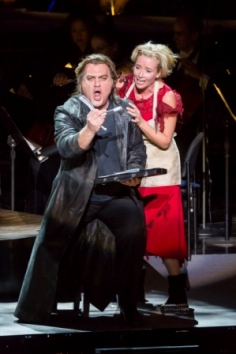
Bryn Terfel and Emma Thompson in Sweeney Todd
(©NY Philharmonic)
The brilliant score of Sweeney Todd doesn’t lend itself well to minimalism, as the 2005 stripped-down Broadway revival of Stephen Sondheim’s classic well demonstrated. There were no such problems with the concert version recently performed by the New York Philharmonic featuring a stellar cast including opera singer Bryn Terfel as the Demon Barber of Fleet Street and, making her New York stage debut, Emma Thompson as his partner-in-crime Mrs. Lovett. The rich, powerful score has never sounded better, with the choral sections in particular providing no shortage of goose bumps. Those not lucky enough to have seen the show during its distressingly short run will be consoled by the knowledge that it was filmed for future broadcast on PBS’s Great Performances.
Hewing to the formula of his successful concert staging of Sondheim’s Company, director Lonny Price provides enough clever theatrical touches to make this far more than a mere recital. That’s evident from the ingenious opener, in which the entire cast troops onstage clad in formal clothing and assumes stiff positions behind music stands. As the music begins, it doesn’t take long for them to topple the stands to the ground, bust up several pieces of scenery, invert a grand piano, and tear off pieces of their clothing. This Sweeney Todd will clearly be no decorous affair.
That level of theatricality is not entirely sustained over the course of the evening, when the limitations of the staging fail to make the plot’s complexities fully comprehensible. But save for newcomers to the work, that’s hardly much of a problem. Its raison d’etre is to deliver the magnificence of the score, and in that it entirely succeeds.
Terfel’s booming bass-baritone voice infuses such numbers as “Ephiphany” and “My Friends” with a chilling ferocity. And though the singer doesn’t quite possess the actorly skills to fully delineate the character’s complexity, his menacingly powerful stage presence provides ample compensation. His Sweeney is perhaps the most frightening since Len Cariou in the original Broadway production.
There had been some advance trepidation about whether Thompson, whose sole previous musical credit was a stint in the 1985 West End production of Me and My Girl, would possess the sufficient vocal chops. But the actress, adopting a pitch-perfect Cockney accent, doesn’t disappoint. Her singing of the challenging score is clear and assured, and deeply moving in such numbers as “Not While I’m Around.” Not surprisingly, her delivery of songs like “The Worst Pies in London” and “A Little Priest” is infused with sublime comic flair. While her antic Mrs. Lovett is somewhat less down and dirty than some of her predecessors—she’s far more lovable than deranged—it’s a wonderful performance whose impact will only be magnified on the small screen.
The members of the ensemble are equally expert in their supporting roles: Jay Armstrong Johnson and Erin Mackey are affecting as the young lovers Anthony Hope and Johanna; Christian Borle is hilariously over-the-top as the rival Italian barber Pirelli; and Jeff Bllumencrantz is entertainingly weaselly as his cohort Beadle. Making his long overdue New York stage debut is three-time Oliver Award-winner Philip Quast, who brings unexpected dramatic shadings to the malevolent Judge Turpin. While lucky audiences at the first few performances were treated to the unannounced appearance of Audra McDonald as the beggar woman, Bryonha Marie Parham, who played the role on Saturday, was an able replacement.
But the true star of the evening is the glorious score featuring Jonathan Tunick’s intricate arrangements as superbly rendered by the 52-member orchestra conducted by Alan Gilbert. Such numbers as “The Ballad of Sweeney Todd” (unforgivably excised from Tim Burton’s ill-conceived movie adaptation) and “City on Fire” register with such a visceral ferocity that the deafening air horn blasts at key dramatic moments seem entirely redundant.
Avery Fisher Hall, Lincoln Center
Review: Die Fledermaus
Jan 16th
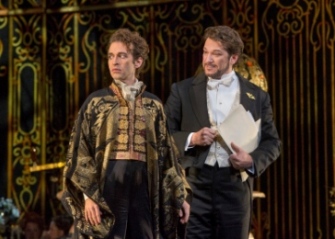
Anthony Roth Costanzo and Paulo Szot in Die Fledermaus
(©Ken Howard/Metropolitan Opera)
The Metropolitan Opera appropriately ushered in the New Year with Die Fledermaus, Johann Stauss Jr.’s classic comedic operetta set on New Year’s Eve. Revised with new English language lyrics and dialogue by theatrical veterans Jeremy Sams and Douglas Carter Beane (Sister Act, Cinderella) respectively, the glittering production manages to entertain despite some glaring missteps that rob the effervescent work of much of its fizz.
Updated to turn-of-the-century Vienna, the new version directed by Sams retains the familiar story of duplicitous Gabriel von Eisenstein (Christopher Maltman) and his long-suffering wife Rosalinde (Susanna Phillips) attending a glittery New Year’s Eve ball at the palatial home of Prince Orlofsky (Anthony Roth Costanzo) at their behest of their friend Dr. Falke (Paulo Szot). Falke is intent on getting revenge on Eisenstein, who is supposed to report to jail for having assaulted a policeman, over a slight years earlier, while Rosalinde is determined to catch her cheating spouse in the act. To that end, she poses as a Hungarian countess who her oblivious husband is promptly intent on seducing. Also present at the ball is the couple’s maid Adele (Jane Archibald), who has pretended to be visiting her dying aunt, and the jail’s warden Frosch (Danny Burstein), disguised as a Frenchman. Farcical complications ensue.
Unfortunately, the usually lighter-than-air piece has here been burdened with reams of expository dialogue that slows the action down and results in a bloated running time of nearly four hours. Both the book and lyrics feature loads of broadly comic, often contemporary jokes that frequently border on bad taste, including an ill-conceived Holocaust reference. The new English language lyrics, often on the order of “Let’s canoodle, my strudel,” prove frequently awkward for the singers, even if they don’t fully detract from the pleasures of the gorgeously melodic score.
Even such seemingly sure-fire comic interludes as Frosch’s fourth wall-breaking address to the audience fall short, despite the spirited vaudevillian shtick by Broadway veteran Burstein (South Pacific, Follies). The comedy routine stuffed with gags referencing such targets as Andrew Lloyd Webber, The Sound of Music, The Cabinet of Dr. Caligari and child molesting priests produces some genuine laughs but goes on far too long.
Other vulgar touches include the sexily revealing costumes worn by the gorgeously lithe dancers at the party and such bizarre aspects of the lavish set designs as the Christmas tree and menorah decorating the Einsenstein’s home.
To be fair, goofy humor has always proved an integral element to productions of this lighthearted work. But the tone-deaf aspects of most of the comic flourishes prove more wearisome than exhilarating.
Still, under the spirited conducting of Adam Fischer, the orchestra and singers do ample justice to the music. Particular standouts include Michael Fabiano, displaying a gorgeous tenor as Rosalinde’s ardent suitor, Alfred; countertenor Costanzo, unveiling thrilling high notes as the outlandishly costumed Orlofsky; and Szot, whose resonant baritone remains ever thrilling.
Metropolitan Opera, Lincoln Center. 212-362-6000. www.metoperafamily.org. Through Feb. 22.
Review: Rigoletto
Feb 5th
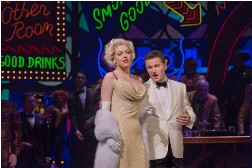
It’s not often you see a half-naked pole dancer cavorting onstage at the Metropolitan Opera House. But that’s just one of the many startling sights in their new production of Rigoletto. Staged by theater director Michael Mayer (Spring Awakening, American Idiot) in his Met Opera debut, this audacious version of Verdi’s 1851 classic has been reset to 1960’s era Las Vegas. And while the updating has the sort of logistical flaws typical of such operatic revampings, it’s an entertainingly robust and imaginative rendition that should attract fresh audiences.
There’s no doubt that we’re no longer in 15th century Italy from the first glimpse of Christine Jones’ lavish set design of a Vegas casino emblazoned with neon signs and the performers clad in Susan Hilferty’s tacky, brightly-colored costumes. Here, the Duke (Piotr Beczala) is a womanizing, Sinatra-style lounge singer in a white dinner jacket, grabbing a microphone to sing his aria “Questa o quella” to an adoring crowd.
The hunchbacked Rigoletto (Zeljko Lucic) is his sidekick, an abrasive, Don-Rickles type comedian. The basic story, adapted from a Victor Hugo play, manages to come through clearly in this conception. The Duke seduces Rigoletto’s beautiful virginal daughter Gilda (Diana Damrau), thereby incurring his wrath. He hires a killer, Sparafucile (Stefan Kocan), to exact revenge, with inevitable tragic results.
This sort of thing has been done many times before, with Rigoletto in particular having undergone numerous transformations in its long performance history, including a famous version staged by Jonathan Miller for the English National Opera that was set in 1950’s Little Italy. But the opera, unlike certain others in the standard repertory, is strong enough to endure such tampering. Here, even the jarringly slang-laden translation delivered via surtitles is more amusing than heretical.
And, as is usual for the Met, the production is beautifully sung. Polish tenor Beczala does beautifully by such familiar arias as La donna e mobile” while delivering a smoothly charismatic performance. Serbian baritone Lucic makes a strong vocal impression as the Duke, even if his acting leaves something to be desired. German soprano Damrau sings luminously as the doomed Gilda, and Slovakian bass Kocan makes for a memorably oily hit man, inspiring chills with his deep rumblings. Belarussian mezzo-soprano Oksana Volkova is also memorable, both visually and aurally, as Sparafucile’s seductive sister Maddalena. Italian conductor Michele Mariotti presides over the proceedings expertly, fully mining the riches of Verdi’s score.
Clever touches abound, such as when Gilda’s near-dead body is disposed of not by bundling it into a sack but instead stuffed into the truck of a vintage Cadillac. During the storm scenes, flash of neon lightning crisscross the set. And Monterone (Robert Pomakov), the count who places a fateful curse on
Purists will inevitably scoff. But there’s no denying that this Rigoletto is a freshly invigorating, especially when compared to such recent Met productions as their drearily monochromatic Don Giovanni. And it will probably play terrifically in its Feb. 16 broadcast as part of the increasingly popular Live in HD series, shown in movie theaters around the world.
Metropolitan Opera House, Lincoln Center. 212-362-6000. www.metopera.org. Through May 1.
Review: Laura Osnes at Cafe Carlyle
Jun 21st
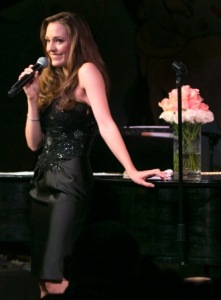
As show business Cinderella stories go, it’s one of the best. In just a few short years, 26-year-old Laura Osnes has gone from unknown reality show competition winner to bona-fide Broadway star. After playing Sandy in the Broadway revival of Grease that was her prize for winning on TV’s Grease: You’re on the One That I Want, she’s gone on to starring roles in South Pacific, Anything Goes, and a Tony nomination for Bonnie and Clyde. Add to that acclaimed turns in the Encores! production of Pipe Dream, a concert version of The Sound of Music at Carnegie Hall, and the title role in the upcoming revival of Cinderella, and it’s easy to imagine what comes next.
A cabaret debut, of course, as has become de rigueur for Broadway leading ladies. And what better place than the swanky Café Carlyle, where the gorgeous, fresh-faced ingénue is delivering an evening that serves as both a showcase for her gorgeous soprano and an audition for upcoming starring roles.
Such as Marian in The Music Man, from which she sings “’Til There Was You.” Or Fanny Brice in Funny Girl, from which she not only belts out “Don’t Rain on My Parade” but also plays a tape of her singing it when she was just a child.
Although it contains touches of sensuality, such as an irony-free rendition of “Fever” and the skintight dress that shows off her perfect figure, the evening is mostly a wholesome one. Romantics certainly swooned on opening night when she brought out her equally adorable husband to sing with her on “A Whole New World” from Aladdin.
Accompanied by a first-rate quartet led by pianist/musical director Fred Lassen, Osnes alternates between selections from her theater repertoire--such as “How ‘Bout a Dance” from the ill-fated Bonnie & Clyde and a rewritten version of “I Have Confidence” from The Sound of Music—and such pop gems as Sara Bareilles’ “Bluebird,” Norah Jones’ “Sunrise” and a couple of songs by Randy Newman, including “When She Loved Me,” movingly dedicated to her late mother.
The opening night crowd was also treated to a special guest appearance by her Anything Goes co-star Joel Grey, who dueted on an endearingly ragged version of “Friendship” in which both forgot lyrics and an amusing “Pineapple Song” from Cabaret.
Although her crystalline voice shines, Osnes still has a ways to go in terms of lyrical interpretation and full emotional connection with her material. But give her some time—she’s still at the beginning of what is undoubtedly going to be a long and successful career.
Café Carlyle, 35 E. 76th St. 212-744-1600. www.thecarlyle.com.